

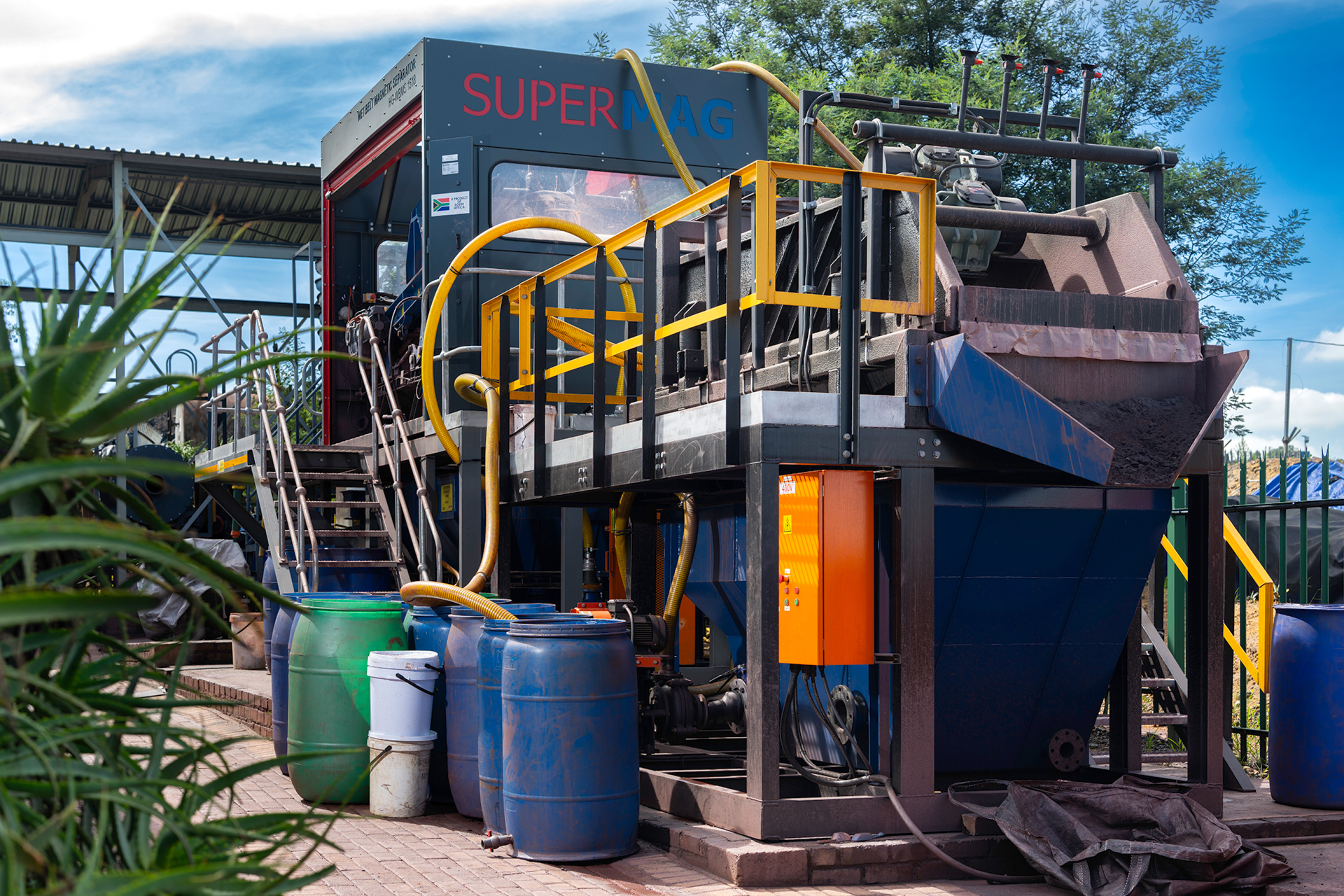
Fraser Alexander’s NXTGEN team is advancing practical solutions to beneficiate fine tailings — a resource class that is technically challenging, yet increasingly strategic as ore grades decline and mining gets deeper. In South Africa, iron and chrome ore are identified on the country’s critical minerals and metals list, strengthening the case for extracting additional value from materials historically left behind in mine tailings.
Fine minerals are difficult to recover because separation physics becomes less forgiving at ultrafine sizes. This increases the need for innovative, integrated flowsheets tailored to specific ore characteristics. The NXTGEN approach combines value extraction with environmental and social considerations, including the potential for more benign tailings streams and reduced tailings volumes. Opportunities to repurpose final tailings also align with circular economy principles.
In 2025, the team conducted several fines beneficiation campaigns comprising desktop-level, laboratory-scale and pilot-scale test work.
Fine Iron Ore
Comparative pilot campaigns focused on the minus 75 µm fine iron ore tailings (IOT) fraction. The test work campaigns, designed and managed by the NXTGEN team, evaluated multiple technologies, including dry and wet magnetic separation (belt-type separators, WHIMS — wet high-intensity magnetic separation, and RED — rare-earth drum separation), as well as gravity-based technologies.
By testing a suite of technologies under comparable conditions, the team strengthened flowsheet confidence and enabled process selection based on ore characteristics.
The test work also extended to dewatering and deposition considerations, including filtration and geotechnical properties, to assess amenability to filtered stack disposal.
Fine Chrome
Bench-scale flotation test work was conducted on UG2 tailings to evaluate the role of flotation within an innovative flowsheet aimed at producing a marketable chromite concentrate (typically 40%+ Cr₂O₃). The programme also assessed the potential to generate a lower-grade, more benign tailings stream.
Following this work and an assessment of the competitiveness within the chrome reprocessing sector, Fraser Alexander initiated a conceptual study to evaluate and trade off different flowsheet options. These included combinations of spirals, flotation and magnetic preconcentration. A preferred flowsheet option was selected and costed, with next steps focused on identifying opportunities for implementation.